Arson and sinking of the Northern Light
Smilla's Sense of SnowThe arson and sinking of the Northern Light is the violent turning point that converts Smilla’s confinement aboard the ship into a desperate escape across the harbor. As the vessel is already moving away from the wharf, a firecracker signals an attack: gasoline catches fire, the diesel tank explodes, and the ship begins to break apart and sink. Smilla jumps into the water and, nearly overcome by cold and exhaustion, reaches the dock beside the burning wreck. The scene makes survival depend on a narrow interval between two lethal spaces: the ship engulfed in fire and the harbor’s freezing water.
The Ship Begins to Move
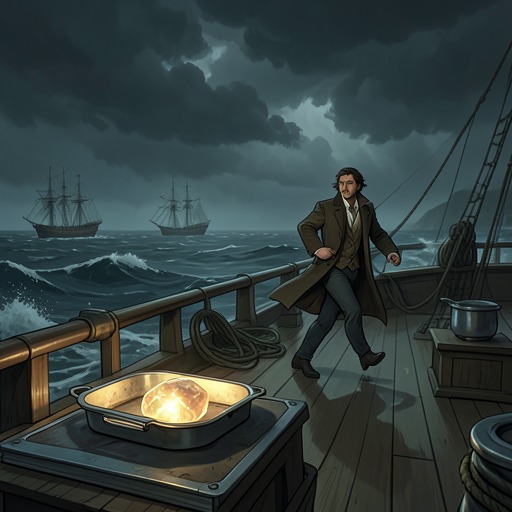
The attack unfolds while Smilla is trapped aboard. The engine starts and idles, then the ship slowly swings away from its berth; from a bedroom with portholes facing the dock, she sees the wharf receding into darkness. The movement leaves her alone on a vessel whose engine is running and whose course is no longer under her control. The ship’s motion, at first a sound and a shifting outline, becomes the condition that makes escape harder.
A small spark appears on the dock. It rises and arcs toward Smilla, trailing embers; she recognizes it as a firecracker just before it bursts above her head. The flash blinds her. At the same instant, the fire draws the oxygen from the air, and she throws herself to the floor. Gasoline has been poured over the ship. The assault is not a single blast but an attack that surrounds her: the flash, the depleted air, and the fire close in while the vessel continues to move.
Fire Takes the Vessel
The fire illuminates the room through the skylights after their covering burns away. Muffled explosions sound on deck, and the light flickers blue, then yellow, before the air fills with the smell of burning epoxy paint. In the bedroom, smoke begins to seep inside. Through the portholes, the fire’s reflections make the soybean-factory silo appear lit by sunset and the windows along Iceland Wharf glow like molten glass. The heat and spectacle do not offer a way out; they show how fully the blaze has taken hold around her.
The diesel tank then blows up. The narrator describes not a conventional explosion but a whistle swelling into a roar. The blast tears away the bed and the wall adjoining the engine room, exposing the engine amid its network of pipes. It breaks free and sinks into the sea, where it causes explosive boiling; burning diesel spreads across the water in tongues of flame. What should be a route of escape is also part of the fire.
The stern turns into an open gateway facing Iceland Wharf, and the whole ship slowly rotates away from the burning oil. Yet the wreck is already listing. Water enters the hull and pulls it backward until Smilla is standing knee-deep in it. The ship’s changing position and flooding turn its interior into a shrinking, unstable refuge. The professor comes through the door after his office chair rolls across the careening room; he slams into a bulkhead, rides through what had been his bedroom, and plunges into the water. His appearance marks the wreck’s collapse as an immediate physical danger, not merely a view outside the portholes.
The Jump into the Harbor
Smilla strips off her clothes before making the crossing. The flare from the diesel engine has burned away the fur on her hat and singed the top of her head; she feels blood on her hands. The dock at Svajer Wharf is perhaps two hundred yards away, but the fire blocks the other side. She has no choice but to jump into the water.
The cold forces her eyes open underwater. Firelight makes everything gleam green and red, but she does not look back. She knows that a person in water below 42°F can survive only a few minutes, with the time depending on physical condition; she considers herself in poor shape. Her body’s response becomes a clock. She describes the shaking that begins as body temperature falls from 98.6° to 95°F, then stops as it drops toward the critical 86°F, when apathy sets in. The knowledge does not make the swim safer; it gives precise terms to the process that may kill her.
After a hundred yards, she can no longer straighten her arms. Thinking of the past does not help, and thinking of Isaiah does not help either. She feels as if she is standing on a slope, leaning into a stiff wind, and might as well give up. The scene narrows survival to an effort that cannot be sustained by memory or reflection. What carries her forward is the thought that the attackers may believe they have killed her, and that they consider her a fake Greenlander. She decides to take ten more strokes. On the eighth, she strikes her head against a tractor tire hanging as a bumper beside the berth of the Northern Light.
Survival and the Burning Wreck
With only seconds of consciousness left, Smilla pulls herself onto a platform above the water. In Greenland, a person who has fallen into the sea runs on getting out to avoid freezing; here the air seems wonderfully mild. She realizes the warmth comes from the fire. On the platform she sees the Northern Light in the harbor entrance, a black skeleton of wood inside a white ball of flame. The warmth that lets her remain on the dock comes from the same blaze that has destroyed her refuge.
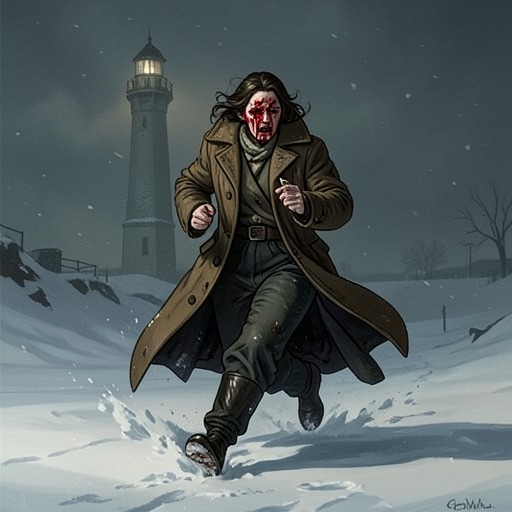
She crawls up the stairs on her hands and knees. The dock is deserted, and she is close to collapse. Her naked skin glows in the firelight; the small hairs on it are singed black and curling. She begins to walk while hallucinations fragment into memories from childhood: a flower she found, worry about whether Eberlein has more brocade for her hat, and the feeling of being sick and wetting the bed. The escape ends not in safety or composure but in a near-collapse, with the fire’s warmth sustaining a survivor whose body and perception have been pushed to their limits.
The sinking changes the stakes of Smilla’s confinement by destroying the ship around her and forcing her to choose between fire and cold water. Its sequence of material failures—the engine starting, the firecracker, burning fuel, the exploding diesel tank, and water entering the hull—makes the vessel itself an active part of the danger. Smilla survives not by mastering either element, but by crossing the harbor in the brief interval before cold can finish what the fire began.